


Demolition Contractors in Purasawalkam
If you're planning demolition contractors in Purasawalkam, the first decision is not the machine. It's what can be removed safely, what must stay, and how the work will be finished without blocking a narrow street or shaking the next house. In this part of Chennai, that judgement matters as much as the breaker.
We handle controlled demolition for old houses, shops, RCC portions and internal alterations where the structure has to come down in a sequence, not in a hurry. You should know what approvals are needed, how debris will leave the site, and where the real risks sit before anyone starts cutting columns or hauling out slabs.
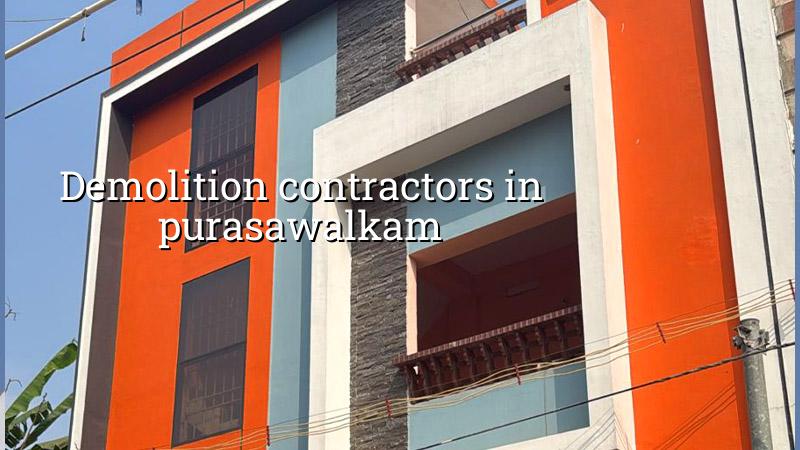
Purasawalkam needs a different demolition plan
Purasawalkam is dense, old and busy. A lot of plots sit on small roads where there is no room to park an excavator, no spare space to stack debris, and no patience from neighbours if hammering starts too early. In a street like this, the sequence of demolition is a site-management problem first and a breaking job second. We plan which wall comes down first, where the debris will be lowered, and how the truck will reach the plot without backing up traffic for half an hour.
Older buildings here also tend to have mixed additions. A front room may be brickwork from one period, while the rear slab or stair is much newer. That is where many bad jobs begin. If someone assumes every part of the building behaves the same, the work becomes unsafe very quickly. We check for concealed beams, shared walls, water tanks, compound walls and service lines before we touch the structure.
The local approval route also matters. Depending on the exact plot location, the building licence may sit with Greater Chennai Corporation, or with the municipality or town panchayat that governs the site. If the property is close enough to fall under Chennai Metropolitan Area planning control, CMDA rules still matter. For a demolition job, the paperwork is usually lighter than for a new build, but it is never wise to skip the document check. One wrong assumption can stop the work after the labour team has already been mobilised.
What we inspect before a single wall comes down
We start with a condition check, not with a quote. The aim is to understand what the structure is made of, how it stands, and what it shares with the next property. On older Chennai buildings, the dangerous part is often not the main frame. It is the attached staircase, the sunshade, the compound wall, or a later RCC slab that was tied into old masonry without a proper record.
The sequence we follow
Controlled demolition works best when the site is opened in a clean order. We do not like random breaking. A proper sequence keeps the load path predictable until the last usable support is removed.
- Site survey and marking — We inspect the structure, mark portions to retain, and identify services to isolate before work starts. This usually takes one visit and a short verification call.
- Disconnect utilities — Water, electrical and any live service lines are cut off and confirmed safe. If this is skipped, damage spreads fast.
- Soft strip — Doors, windows, reusable fixtures and loose interior material come out first. This reduces weight and cuts dust.
- Structural demolition — RCC, brick and slab portions are removed in the planned order, with debris lowered safely and not thrown free-fall.
- Loading and disposal — Debris is stacked, loaded and taken out in stages so the plot doesn't become a dumping ground.
For a small house, the work may move in a few days. For a larger or more awkward structure, especially where access is limited, the pace is slower because safety and neighbour control decide the rhythm. That is normal. The wrong lesson is to equate speed with skill.
How to verify a demolition contractor
People usually call us after a bad quotation from someone who only said, "We'll break it and clear it." That is not enough. A proper demolition contractor should tell you what will be removed, what remains, how debris leaves, and who is responsible if a shared wall cracks. Ask for the method, not just the price.
Check the documents, too. You should see a written scope, a debris disposal plan, a milestone-based payment schedule, and the name of the engineer who will supervise. If a contractor cannot explain how they will protect the adjacent property, they are not ready for an old Chennai site. In Purasawalkam, that question is not theoretical. The next building is often very close.
- Ask which portions are included: full demolition, partial demolition, or only soft strip and disposal.
- Ask how utilities will be isolated before work begins.
- Ask how debris will be lowered and where it will be loaded.
- Ask who supervises the site every day and how neighbour complaints are handled.
- Ask for the BOQ before you sign anything, not after mobilisation.
- Ask what happens if concealed RCC or a shared wall is found during execution.
A fair contract should name the scope, debris disposal method, safety responsibility, timing, payment stages and exclusions. It should also say what is not included, because demolition projects go wrong when someone assumes cutting, carting and tipping charges are all covered. They often are not.
What affects demolition cost
For demolition work in Chennai, the rate is driven by access, structure type, height, reinforcement and disposal distance. Site tightness changes the job more than most people expect. A building on a wide road with truck access is not the same as a front-locked property on a narrow lane. Manual breaking, controlled lowering and repeated debris handling all add labour.
Indicative demolition cost can sit inside the broader construction rates, but demolition is not priced like a normal per-sq-ft build. If a contractor gives you a casual lump sum without checking the site, that number is weak. We use a BOQ so the real figure is settled before work starts. The cost drivers usually sit in one of four places: structure type, access, disposal distance and the amount of RCC in the building.
| Cost driver | What it changes | Why it matters on site |
|---|---|---|
| RCC content | Breaking time and tool wear | Slabs and beams take longer than brick walls |
| Access width | Labour effort and machine choice | Narrow lanes force manual handling and staged loading |
| Neighbour proximity | Protection work and work-hour control | Shared boundaries need careful sequencing and dust control |
| Debris disposal | Loading and transport effort | Longer haul distances increase the final bill |
If the job is only internal demolition or selective removal, the spend is lower. If the structure is heavily reinforced or sits in a cramped lane, the work becomes slower and more careful. Saving money by avoiding a site survey is a false saving. The mistakes show up as cracked walls, broken lines, unsafe debris piles and arguments with the neighbour next door.
Approvals, safety and the part people miss
Most homeowners ask about permission only after the labour team has already been lined up. That's late. For demolition, the relevant authority depends on where the property sits: Corporation, municipality, town panchayat or cantonment area. If the site is in a regulated part of the Chennai metropolitan area, planning control still matters. Buildings near the airport side can also face height and aviation-related checks if the work involves taller portions or crane movement.
We also look at the practical safety side. Dust control, barricading, debris stacking, and daily housekeeping are not cosmetic items. They decide whether the work can continue smoothly. In an old dense area like this, the site has to stay readable. If debris spreads across the frontage, people start complaining before the demolition is even halfway done.
What a clean demolition job usually needs:
- Utility isolation before breaking starts
- Protective barricading around the frontage
- Daily debris removal, not end-of-job dumping
- Careful handling of shared walls and adjacent foundations
- Engineer supervision on site, especially during RCC removal
How we work
We handle demolition with the same in-house team we use on construction jobs. Our civil engineers, structural engineer and architect review the structure, and a site engineer is on site every working day. For clients who cannot visit, we send weekly photo updates by WhatsApp. Before any contract is signed, we prepare a detailed BOQ so you know what is included and what is not. If the job is to remove a house, a shop frontage or an RCC portion before rebuilding, call us on +91 97107 13838 or write to info@shalomconstruction.com. Our office is at No. 45, 2nd Main Road, Abirami Nagar, Koladi, Thiruverkadu, Chennai – 600077.
Frequently Asked Questions
When a demolition job is done properly, the site feels boring by the end. No stray debris, no fight over damage, no mystery charges. That is the standard worth asking for in a place like Purasawalkam.
Demolition Contractors in Purasawalkam
Send us the site location and a photo set, and we'll tell you what needs a visit and what can be priced from the first review.
Request a Quote Call +91 97107 13838