


Demolition Contractors in Madipakkam
If you need demolition contractors in Madipakkam, the first question is not how fast we can break the building. It is how we’ll bring it down without cracking the neighbour’s compound wall, blocking the street, or leaving you with a pile of mixed rubble and no one to take it away.
Most people call us when they have an old house to clear, a risky wall to remove, or a redevelopment plan waiting on a clean site. In Madipakkam, the work needs more planning than force because access is tight in many streets, houses sit close together, and rainwater can sit in low pockets if the debris is not cleared on time.
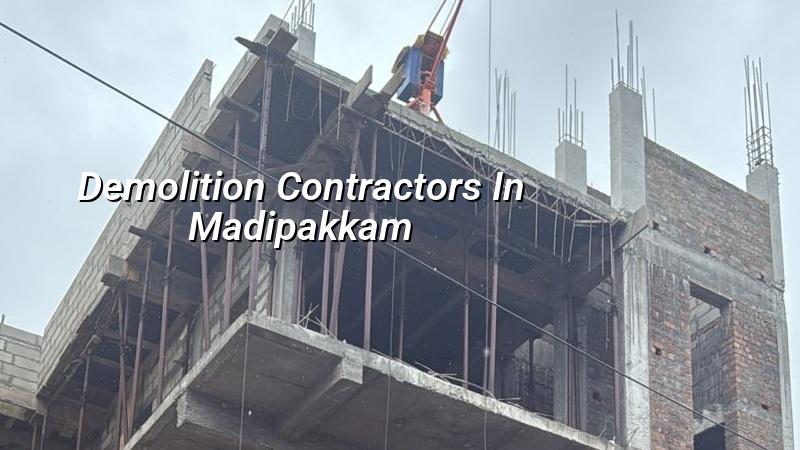
Why Madipakkam demolition needs planning first
Madipakkam is a dense residential area next to Velachery, and many plots sit in streets where a tipper truck cannot simply park for long. That changes the job from brute demolition to sequence planning. We look at how the machine or labour gang will enter, where the rubble will be stacked for a short time, and how soon it can move out without upsetting traffic or the next house. In a place that drains slowly in some pockets, leaving broken masonry on site after a shower turns a two-day job into a week of mud and complaints.
The other point is the age of the building stock. A lot of homes in this belt have gone through extensions, room additions and terrace closures. A wall that looks like ordinary brickwork may be carrying a slab edge or a toilet line from a later alteration. We don’t assume. We open up, inspect, and decide what can come down with hand tools, what needs controlled mechanical breaking, and what must stay until the new structure is ready.
What we take down, and what we leave standing
Demolition is not one activity. There is selective dismantling, partial demolition, full building demolition, RCC breaking, roof slab removal, and site clearing. If you are planning a rebuild, the safest sequence is usually to strip out doors, windows, wiring, plumbing fixtures and loose fittings first, then move to the roof and upper structure, and only then attack the main walls and foundation elements that are marked for removal.
We use IS 456:2000 and NBC 2016 as part of the technical frame when RCC elements are involved, and we plan the work so loads are not left hanging on half-cut members. In Chennai, with Seismic Zone III conditions under IS 1893:2016, careless cutting is how people create surprises they did not budget for. The wrong wall comes out first, or a beam is weakened before shoring is in place, and then the damage is no longer local to the demolition area.
Hand demolition or machine demolition?
For many Madipakkam sites, hand demolition is still the better choice near the boundary lines. It is slower, yes, but it gives control where your neighbour’s wall is only a few feet away. Machine work makes sense when the plot is open enough, the structure is larger, and access for a small excavator is possible. The honest answer is that machine demolition is not always cheaper once you factor in protection, transport, and the cost of fixing accidental damage. On small urban plots, a careful manual crew often wins.
We also decide based on what the building is made of. Old load-bearing brick homes behave differently from RCC framed structures. The former can collapse in an ugly way if you remove the wrong support line. The latter can shed heavy concrete pieces that need controlled breaking and proper lifting. If there is an overhead tank, a stair landing, or a compound room tied into the main house, we treat it as a separate task, not as an afterthought.
- Site check and marking — we inspect the structure, identify utilities, mark salvage items and define what will stay. This usually takes half a day to one day.
- Isolation of services — power, water and any active lines are disconnected or protected before breaking starts. Without this step, damage happens fast.
- Top-down dismantling — loose items, roof elements, doors, fittings and then structural members are removed in sequence over one to several days, depending on size.
- Rubble sorting and carting — usable steel is separated, concrete and brick debris are loaded out, and the site is levelled for the next stage.
- Final cleanup and handover — we clear sharp edges, remove loose fragments and leave the plot ready for survey, foundation work or a fresh layout.
How to judge a demolition job before you hire
If you are comparing demolition contractors, ask for more than a price. A proper contractor should tell you how the building will be taken down, how rubble will be moved, and who is responsible if a line, wall or gate is damaged. A fair job includes clear method, clear scope and clear disposal terms. If those three are vague, the cheap quote will usually turn costly halfway through.
- A written scope that says full demolition, partial demolition, or selective dismantling.
- Proof that the contractor has checked for live services before breaking begins.
- A rubble removal plan that names who loads, who transports and who disposes.
- Protection measures for the neighbour side, including dust suppression and debris control.
- A payment stage tied to progress, not just a lump sum paid on day one.
- A clear statement on salvage items such as steel, teak doors, tiles or granite slabs.
Approvals, safety and the things people skip
For demolition in Chennai, the approval path depends on where the plot sits. In many cases the local body matters as much as the contractor. Inside city limits, the Corporation route applies; outside it, the municipality or town panchayat route applies. If the plot is in a special body area, the procedure changes again. For Madipakkam, the paperwork is usually tied to the local authority and the building records, and it is smart to settle that before anyone starts breaking walls.
The documents people usually forget are the ones that save trouble later: patta, encumbrance certificate, FMB sketch where available, and any drawings or stability papers that support the work. If the structure is tied to a redevelopment plan, you also want the new-build side sorted early, because a demolished plot sitting idle invites waterlogging, neighbour disputes and stray dumping.
| Work type | Typical condition | What we control |
|---|---|---|
| Selective demolition | One room, wall, slab portion or terrace addition | Cut line, shoring, vibration and dust |
| Full house demolition | Old independent house to be rebuilt | Sequence, debris removal and site clearance |
| RCC breaking | Slab, beam, staircase or roof projection | Member stability and safe breaking order |
| Site clearing | Plot already dismantled, debris still present | Sorting, loading and final levelling |
Typical sequence and timeline
The real timeline depends on size, access and whether the structure is load-bearing or RCC framed. A small selective demolition may finish quickly, while a full house with tight access takes longer because the rubble has to move out in smaller loads. The job slows down further if a compound wall, live neighbour line or shared drain has to be protected. We do not guess the duration from the road name. We look at the building and tell you the likely sequence before work begins.
For a normal residential demolition, the practical order is simple: confirm scope, disconnect services, isolate the area, dismantle from the top, break the main members, cart debris, and clean the site. If any of those are skipped, the same mistake comes back later as a crack, a delay or a dispute. The second week is where people often notice what was missed, because that is when the dust settles and the hidden damage shows up.
How we work on demolition sites
We handle demolition with in-house civil engineers and a site engineer on the ground every working day. We prepare the BOQ and scope before work starts, so you know what is included and what is not. If the job is part of a rebuild, our structural team looks at the next stage too, because a demolition plan that ignores the future foundation layout can waste time and money. If you want us to check a Madipakkam site, call +91 97107 13838 or write to info@shalomconstruction.com. Our office is at No. 45, 2nd Main Road, Abirami Nagar, Koladi (Landmark: Ratna Chamber), Thiruverkadu, Chennai – 600077.
Frequently Asked Questions
If you are planning a rebuild, don't start with the breaker. Start with the sequence, the access path and the disposal plan. Those three decide whether the site is ready for the next contractor or still a mess by the time the first monsoon shower arrives.
Demolition Contractors in Madipakkam
Send us the site details and we’ll tell you the safest way to approach it, then prepare a BOQ-based quote and schedule a visit.
Request a Quote Call +91 97107 13838