


Demolition Contractors in Koyambedu
If you need demolition contractors in Koyambedu, the first question is not how fast the wall comes down. It is how safely we take it down without shaking the next flat, the beam you meant to keep, or the shop front that still has to stay open tomorrow.
Koyambedu is not a place where you can treat breaking work like routine civil work. The market traffic, tight access in many blocks, and mixed old and newer buildings mean the job lives or dies on sequence, barricading, debris removal and control of vibration. We handle demolition with the same care we use before a rebuild.
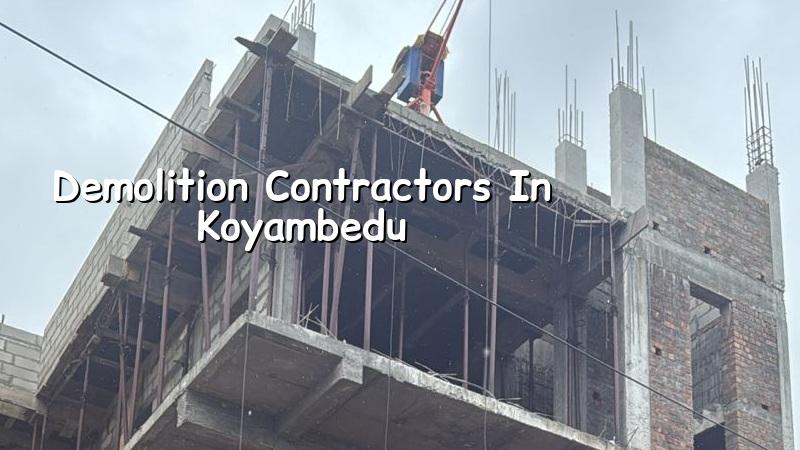
What makes Koyambedu different
Koyambedu sits at one of Chennai’s hardest working junctions. Heavy vehicles move through the area, shop deliveries can't wait, and a demolition site often has little room to stack debris or park a breaker. That changes the order of work. We check where the debris will go before we touch the slab, because a neat demolition that blocks the road or the neighbour’s entrance is still a bad job.
Older structures here can hide a mix of brick partitions, RCC members, sunken service lines and patched repairs from earlier alterations. The safe approach is not to assume the building behaves the way the drawing says it should. We inspect the frame, identify load-bearing walls, isolate services, and decide what can come down by hand and what needs controlled mechanical breaking.
That matters more in Koyambedu than in a wide open site. If the street is narrow, you may need debris bags, smaller tipper trips, timed loading or a hand-loading sequence. If the plot is part of a redevelopment, the next stage starts only after the site is cleared to a level where survey and foundation setting can happen cleanly.
How demolition should be done
Demolition is not one action. It is a sequence. The wrong order is what causes wall cracks next door, dust complaints, cut utility lines and delays that eat into the rebuild budget. On a Chennai site we follow a simple logic: disconnect, inspect, support where needed, remove the light elements first, then proceed to heavier structural members only after the load path is understood.
What we look at before the first cut
We start by identifying electricity, water and drainage connections, then we see whether any part of the structure is shared with an adjoining property. In older rows of buildings, you can find parapets, balconies or walls that were altered years ago and no longer match the original frame. A good demolition contractor notices that before the breaker starts.
For partial demolition, such as removing a staircase block, rear extension or damaged roof section, temporary supports may be needed. For full demolition, the plan usually includes barricading, dust suppression, segregated debris loading and a clear exit route for trucks. If those things are not planned, the site will tell on you by day two.
- Site inspection and marking — We identify what stays, what goes, and where the risks are. Usually 1 working day for a normal house or small commercial structure.
- Utility disconnection and protection — Power, water and any live services are isolated before breaking starts. This step is non-negotiable.
- Selective dismantling — Doors, windows, loose masonry, tiles and non-structural parts come off first. This reduces sudden load shifts and keeps reusable material separate.
- Structural demolition — RCC members, slab portions and load-bearing elements are removed in a controlled order, with dust control and debris handling running alongside.
- Debris loading and site clearance — Waste is loaded out as the work proceeds, not left in a heap. That keeps access open and reduces complaints.
- Final inspection and handover — We check that the plot is clean, level to the agreed extent, and ready for survey, excavation or the next contractor.
What you should verify before appointing anyone
People who ask for demolition work often look only at the quote. That is how they get trapped. A low price can hide no barricading, no debris disposal, no labour for hand sorting, or no proper sequence. When demolition is done badly, the cost appears later as neighbour damage, broken utilities, extra transporter trips or a foundation line that has to be reworked.
If you are comparing demolition contractors in Koyambedu, ask for the plan before you ask for the rate. A fair contractor should be able to tell you how the building will be brought down, where the debris will go, what is excluded, and what protection is being given to adjoining structures. That conversation is more useful than a flashy promise.
- Ask whether the quote includes debris loading and disposal, not just breaking.
- Check if the contractor will identify and isolate live electrical and water lines before work starts.
- Confirm whether the method is full demolition or selective demolition, because the labour and risk are very different.
- See how they handle dust, noise and access on a crowded street or shared compound.
- Ask who is supervising on site every day and who answers if a neighbour raises a complaint.
- Make sure the contract says what is kept, what is removed and what happens if hidden structural damage is found.
Cost and approval points
Demolition pricing is not a single rate. It changes with structure type, floor count, access, debris volume and whether the site allows a machine or only hand work. For demolition, the real cost driver is often disposal, not the act of breaking. In a dense area like Koyambedu, truck movement and loading time can matter as much as labour.
We do not give a fake blanket figure and call it a quotation. We inspect the site, understand the structure, and then prepare a BOQ so you know what is covered. If the work is part of a redevelopment, the paperwork may also involve the local body and, in some cases, supporting documents for the next approval stage. Koyambedu falls within the Chennai metropolitan planning context, so the plot’s exact jurisdiction decides which authority sees what paperwork.
On Chennai demolition jobs, the safer sequence is always cheaper than a rushed one. You may save a day by skipping selective dismantling, but you can lose a week if the wrong wall comes down first or debris blocks the road and the loader cannot return. That is the trade-off most owners underestimate.
| Demolition type | Typical use | What drives the effort |
|---|---|---|
| Selective demolition | Kitchen, extension, staircase, damaged portion | Protection of the remaining structure, hand work, careful sorting |
| Full building demolition | Old house, small commercial block, redevelopment site | Access, debris volume, floor count, neighbour protection |
| Manual demolition | Tight lanes, shared walls, sensitive sites | Labour time, dust control, slower debris movement |
| Machine-assisted demolition | Open sites with proper access | Equipment reach, safety barricades, disposal logistics |
When demolition is the wrong answer
Not every cracked or distressed building needs demolition. That is the honest part many people skip. If the problem is localised corrosion, a failed slab patch, plaster failure or a non-structural extension, renovation may be the better choice. If the frame is still sound, tearing the whole structure down only spends money twice.
The mistake we see often is owners deciding the building is “weak” after a visible crack, without a structural check. In Chennai, cracks can come from settlement, poor previous repairs, water seepage, thermal movement or changes made by an earlier owner. We first inspect the frame, support condition and damage pattern. If the frame is repairable, we say so. If it is not safe, we say that too.
For full redevelopment, demolition is usually the right move when the structure is beyond economic repair, the plan needs a different footprint, or the existing frame has repeated failure points. But if the site is short on access and full of adjoining risks, the decision has to include the method, not only the wish to start over.
How we work on these jobs
We keep demolition practical. Our in-house civil engineers and structural engineer review the site, and a site engineer is present daily. Before any contract is signed, we prepare a detailed BOQ and spell out the stages, the exclusions and the debris plan. If you cannot visit every day, we send weekly photo updates by WhatsApp. For sites in and around Chennai, that usually saves a lot of confusion.
We also work with the next stage in mind. If demolition is for a rebuild, we think about survey points, foundation level, soil investigation and access for the next team, not only the breakage itself. You can call us at +91 97107 13838 or write to info@shalomconstruction.com if you want a site visit and a straight answer.
Frequently Asked Questions
If you are planning demolition in Koyambedu, start with the structure, not the sledgehammer. A careful first visit saves you from a bad contract and a messy site. We can inspect, explain what should come down, and tell you honestly if repair is the better option.
Demolition Contractors in Koyambedu
Need a site visit, a safe demolition plan or a BOQ before you begin? Speak to us and we will tell you what can be removed, what must stay and how the debris will be handled.
Request a Quote Call +91 97107 13838