


Demolition Contractors in Medavakkam
If you need demolition contractors in Medavakkam, the first question is not how fast we can break it down. It is what has to come down safely, what must stay alive, and how the debris will leave a tight residential street without upsetting the neighbours.
Most calls from this side of Chennai come from an old house being rebuilt, a tiled roof that has failed, or a wall that sits too close to the next plot. We handle that work with a site engineer on location, a plan for manual or mechanical dismantling, and a BOQ before anything is signed.
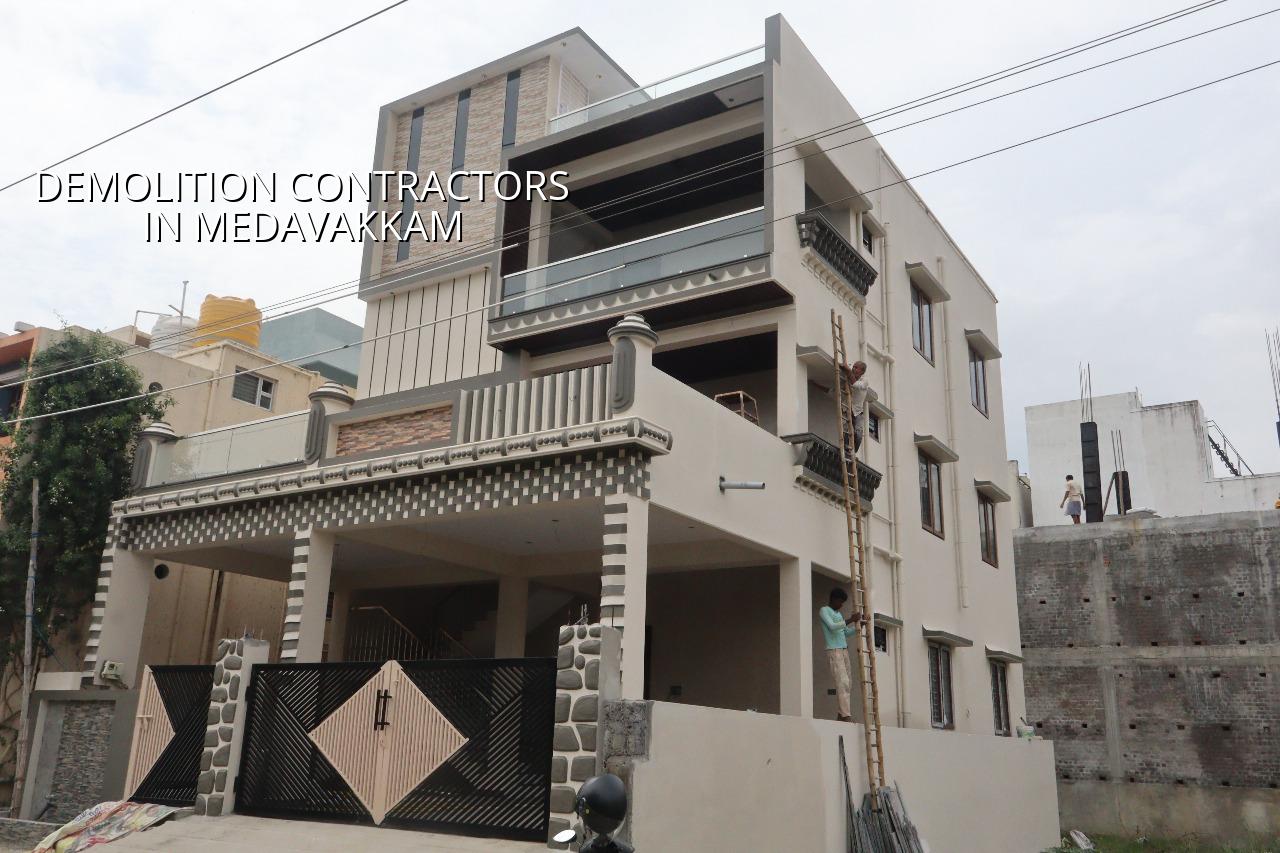
Why Medavakkam needs a careful demolition plan
Medavakkam is not a place where you can assume open access or easy truck movement. Many plots sit in dense residential layouts with one usable frontage, and once a compound wall or an old structure starts coming down, the next issue is where the debris will be stacked for even a few hours. If the street is narrow, we often split the work into smaller shifts so the block is not shut down and the neighbour does not wake up to falling dust.
The ground here also matters. In low and slow-draining pockets around this part of south Chennai, demolition is tied to drainage, plinth correction and rebuilding level decisions. If you remove an old structure without planning the new site level, you can create a water problem before the new foundation even begins. That is the kind of mistake people regret in the first monsoon.
For many owners, the real pressure is timing. A family wants the old house cleared before new approval drawings are submitted, or before loan disbursal starts asking for site readiness. We keep that sequence in mind because demolition is rarely an isolated job. It is the first physical step in a rebuild, and it should leave the plot ready for the next team, not messy and uncertain.
How we remove a structure
We do not treat every demolition the same. A single-room shed, a compound wall, a ground-plus-one house and a partially damaged RCC frame all need different sequencing. Before any cut or break point is fixed, we check for live services, adjacent walls, structural cracks, access for labour, and the safest way to lower the load instead of letting it fail in one shock.
What gets inspected first
The first visit is about deciding what is safe to touch and what must be isolated. We look at the roof type, wall thickness, slab condition, staircase, tanks, service lines and neighbour boundaries. If there is an existing crack pattern, we read it before starting, because a wall that is already failing can shift differently from one that is still carrying load. The wrong sequence is where most damage to adjoining property happens.
- Site check and isolation — 1 visit and a short marking exercise to identify services, weak zones and access points.
- Disconnect utilities — electricity, water and any live service lines are cut off before physical work starts.
- Top-down dismantling — roof, slabs, beams, walls and finally floor elements are removed in a controlled order.
- Debris segregation and loading — reusable material, metal and mixed rubble are separated where practical, then loaded out.
- Final clearing and handover — loose waste, sharp edges and unsafe projections are removed so the plot is ready for the next stage.
Safety is the real work here
Demolition fails when people think it is only about force. The work is actually about sequence, support and restraint. RCC members behave differently from brick walls, and a roof that looks sound from below can be brittle at the edges. Our structural engineer and site engineer check the working order so that the team is not pulling from the wrong point or dropping pieces onto the wrong side of the compound line.
On an occupied street, dust control matters as much as strength. We use watering, manual handling where the machine cannot enter, and a daily clean-up routine so the site does not become a public nuisance. If the access is too tight for equipment, we say so at the start. That is not a failure. It is better than promising machine demolition where only hand dismantling is possible.
- Live electricity must be isolated before any cutting or breaking starts.
- Neighbouring compound walls should be checked for shared support or hidden contact points.
- Debris should not be pushed blindly into low corners where water will collect later.
- Any dismantling near a staircase or slab edge needs extra watchfulness, because collapse often starts there.
- If the road is narrow, loading timing should match local traffic and school hours.
What a fair demolition contract includes
A proper demolition contract is clear about scope. It should say whether the work is labour-only, equipment-assisted, or includes loading and disposal. It should also say who disconnects utilities, who arranges permissions if needed, how debris is handled, and what happens if hidden conditions are found after the first layer is opened. A vague quote is where disputes begin.
The rate depends on the structure type, access, height, slab system, site congestion and disposal distance. We do not give a flat project price on a public page because no two plots in Medavakkam behave the same. A compound wall in an open layout is one thing. A two-storey house with a tight setback and no loading space is another. The BOQ settles the real figure before you commit.
| Work type | What usually changes the effort | Indicative note |
|---|---|---|
| Compound wall demolition | Length, thickness, access for loading | Often the simplest, but debris removal still needs care |
| Single-floor house dismantling | Roof type, wall condition, neighbour proximity | Manual work is common where access is tight |
| RCC partial demolition | Slab span, beam layout, support sequence | Needs a structural eye before any break is started |
| Full-site clearing | Debris volume, loading method, disposal distance | Quote depends on what must be taken away and how far |
What you should check before you hire anyone
If you are comparing demolition contractors in Medavakkam, ask for more than a rate. You need a sequence, a disposal plan and proof that someone technically responsible has looked at the structure. A lower quote can be false economy if it ignores transport, labour for hand dismantling, or the risk of breaking the adjoining wall. One cracked neighbour wall can cost more than the entire demolition bill.
- Ask who will supervise the site every working day.
- Ask how they handle electricity disconnection and debris disposal.
- Ask whether the work is manual, mechanical, or a mix of both.
- Ask what they will do if the slab, beam or wall behaves differently from expected.
- Ask for a BOQ or written scope before payment starts.
How we work on demolition jobs
We start with a site visit, not a sales call. Our civil engineer and structural engineer review the plot, the access and the existing structure, then we prepare a practical scope with the sequence and cost heads. A site engineer remains on the job each working day, and clients who cannot visit get WhatsApp photo updates. If the plan involves a rebuild, we can align the demolition with our residential or renovation team so the next stage starts without delay. Call us on +91 97107 13838 or write to info@shalomconstruction.com.
Frequently Asked Questions
If your plot is ready for rebuild, we can help you clear it in a way that leaves the next stage clean. That matters more than most owners think, especially in a dense area where one careless day can create a neighbour dispute that lasts weeks.
Demolition Contractors in Medavakkam
Send us the site details and we will arrange a visit, prepare the scope and share a BOQ-based quote before any work starts.
Request a Quote Call +91 97107 13838