


Best Builders in Adyar
When you search for the best builders in Adyar, you are usually trying to avoid one expensive mistake: choosing a firm that talks well but cannot handle an older, tight site near the coast. In this part of Chennai, the ground, the access road and the finish level all affect the build.
What you need is not praise about a company. You need to know how to verify the builder, what a fair contract should contain, and what Adyar changes in the actual work. That is what we cover here, with the checks we would use on our own job.
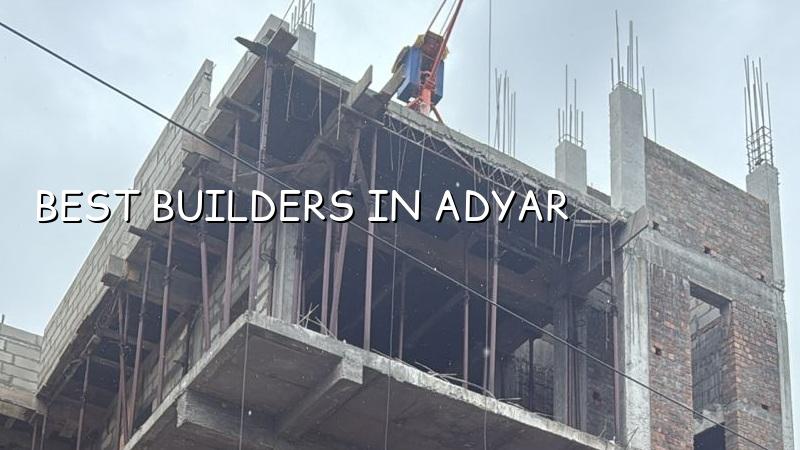
What Adyar changes on site
Adyar is an established part of South Chennai, with older independent houses, mature trees and a lot of plots that were not designed for easy modern construction. Access is often tighter than people expect. On a weekday, a mixer or lorry can block the street if material timing is poor, and that becomes a neighbour issue before it becomes a construction issue.
The other thing people miss is the coastal edge. You are not on the beach like Besant Nagar, but salt in the air still matters for reinforcement cover, exterior coatings and the parts of the building that sit exposed to rain and wind. A builder who treats every Chennai site the same will miss that detail. That is how hairline rust marks and premature paint failure begin.
Adyar also has a lot of work that is not greenfield construction. Some plots involve demolition, some involve partial retention of an old structure, and some need careful staging because the family is living next door. Those are not the jobs for a team that only knows open layouts and straight roads.
How we judge a builder here
If you are comparing firms, start with proof, not promises. Ask for the detailed BOQ before signing anything. Ask who actually signs off the structural drawings, who visits the site every working day, and how the builder handles client visits when you cannot come in person. A serious team will answer plainly.
We also look at the contract itself. A fair contract should say what is included, what is excluded, how milestone payments work, and what happens if the scope changes after the first drawing set. The document should match the BOQ. If the contract is vague and the BOQ is thin, the final bill usually grows in ways that are hard to contest later.
For homes in Chennai, the design should follow IS 456:2000 for RCC work, IS 1893:2016 for seismic design, IS 875 for loads, and NBC 2016. That sounds technical, but it is really about one thing: the building has to stand up properly and behave sensibly when the weather turns ugly in the monsoon.
What a good builder should show you
Do not be shy about asking for these papers and details. The builder who is prepared will not be offended.
- Soil investigation before foundation design, not after construction starts.
- A BOQ that separates civil work, electrical, plumbing and finish items.
- Structural drawings reviewed by a structural engineer, not a sales person.
- Milestone-linked payment stages written into the agreement.
- Weekly photo updates if you cannot visit the site regularly.
- Clear answers on who handles CMDA-related drawings and the local licence process.
- Site reading — we inspect the plot, the approach road and the existing surroundings before design starts. That usually takes a few days, because one rushed visit is not enough.
- Soil test and concept — the foundation choice follows the test result. If the log shows softer layers, we plan accordingly; if the ground is firm, the foundation can be simpler. This stage normally runs for one to two weeks.
- Drawings and BOQ — architecture, structure and service coordination are prepared together. A proper BOQ takes time, but it saves arguments later. Expect one to three weeks depending on revisions.
- Approvals and mobilisation — CMDA rules, the local licence body, drainage details and other papers are prepared for the specific plot. Mobilisation follows only after the paperwork is aligned.
- Execution and checks — excavation, footing, column, slab and finish work proceed with site-engineer supervision every working day. We check steel, shuttering, concrete placement and curing at each stage.
How to verify a builder before you sign
The quickest way to compare firms is to ask the same questions and see who answers cleanly. You are not looking for polished language. You are looking for consistency between the drawings, the BOQ and the contract.
A builder can sound confident and still be weak on the part that matters: coordination. If the architect, structural engineer and site engineer are all separate people who do not speak to one another, small errors turn into rework. That is where money disappears. It is also where schedules slip by weeks.
In our view, the safest choice is the builder who can explain the foundation decision, the finish levels and the payment stage without hand-waving. If they start promising a vague all-in rate before soil and drawings are settled, pause there.
| What to check | What a good answer looks like | What to reject |
|---|---|---|
| BOQ | Item-wise, before contract signing | Only a lump sum with no breakup |
| Soil test | Done before foundation design | Skipped to save time or money |
| Site supervision | Engineer on site every working day | Occasional visits only |
| Material control | Steel, cement and finish specs written clearly | Brand and grade left open-ended |
| Payment plan | Milestone-linked stages in the contract | Large advance with no structure |
Cost, approvals and the trade-off people miss
For residential construction in Chennai, standard finishes usually sit around ₹1,900 to ₹2,300 per sq ft, mid-premium work around ₹2,300 to ₹2,800 per sq ft, and premium or luxury work from ₹2,800 to ₹3,500+ per sq ft. That figure moves with soil and foundation type, number of floors, span, finish level and site access. The BOQ settles the real number before any contract is signed.
The trade-off is simple. You can save money by reducing finish level, simplifying the plan and keeping spans reasonable. That is sensible. You should not save money by weakening the foundation, skipping soil test, or buying cheap waterproofing and exterior paint. Those savings usually come back as repairs, and repairs in an occupied house are always more annoying than the first build.
Approvals also affect timing. In the Chennai Metropolitan Area, CMDA is the planning authority, while the building licence comes from the Greater Chennai Corporation inside city limits or from the relevant municipality or town panchayat outside it. Near the airport side, AAI height clearance can also come into play. Patta, EC, FMB sketch, approved drawings, stability certificate and drainage details are commonly needed.
How we work
We keep the technical work in-house with civil engineers, a structural engineer and an architect. A site engineer is on site every working day, and clients who cannot visit get weekly photo updates by WhatsApp. Mr. D. Salamon Ashok Rajan reviews projects personally, and we write the BOQ before any contract is signed. If you want to discuss a home in Adyar, call +91 97107 13838 or email info@shalomconstruction.com. Our office is at No. 45, 2nd Main Road, Abirami Nagar, Koladi, Thiruverkadu, Chennai – 600077.
Frequently Asked Questions
Good builders are easy to spot once you ask for the right papers. They do not hide the boring parts. They talk about soil, access, approvals and payment stages before they talk about glossy finishes.
Best Builders in Adyar
If you want a BOQ-based quote or a site visit in Adyar, call us and we will start with the plot, the approvals and the work scope.
Request a Quote Call +91 97107 13838