


Aluminium Fabrication Contractors in Nolambur
If you need aluminium fabrication contractors in Nolambur, the real question is not who sounds cheapest. It is whether the work will sit straight on your wall, stay quiet in wind, and keep its finish through a wet Chennai season.
Most calls we get for this kind of work are about grill frames, partition work, balcony railings, window sections, shop fronts, and the small site adjustments that decide whether the finish looks tight or tired. This page tells you what to check, what usually fails, and how we approach fabrication when the plot is in a dense west Chennai neighbourhood.
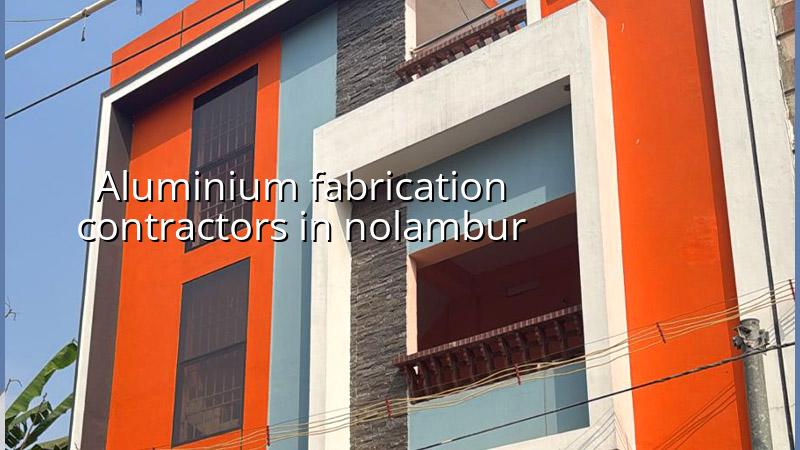
What Nolambur changes on site
Nolambur is not an easy, empty-layout site where materials can be dropped anywhere and corrected later. It sits in a built-up west Chennai belt with apartment blocks, regular residential plots, and a fair amount of road-side activity, so access, storage, and neighbour coordination matter as much as the aluminium section you finally choose. If the truck cannot stop close to the work zone, every extra carry adds time, scratches, and excuses.
We also treat the local approval and fixing sequence carefully. If the work touches a façade, balcony edge, or common area in an apartment, the owner association or builder side usually wants drawings, measurements, and a clean fixing plan before anyone allows drilling. In a narrow site, the sequence becomes practical: measure first, mock up if needed, cut off-site where possible, then install in one visit rather than keep returning with half-finished pieces.
The other local factor is weather. Chennai heat expands sections, then the monsoon brings water into every weak joint. A neat-looking aluminium job can still fail if the fixing line is sloppy, the sealant gap is ignored, or the powder-coated surface is scratched during delivery. That is why we plan the site setup before fabrication starts, not after the frame is ready.
What aluminium work should actually include
For home and small commercial work, aluminium fabrication is usually a bundle of material choice, cutting, assembly, fixing, and finish protection. You are not just buying a frame. You are buying how the frame is measured, how corners are joined, what fasteners hold it, and how the fixing line will behave after the first year of heat and rain.
Where the failures start
Most defects we see begin at the joints and the support points. If the member size is too light, the rail flexes. If drilling is rushed, anchors loosen. If the surface finish is damaged during transport, corrosion starts at the scratch and spreads from there. In a place like Nolambur, where many jobs happen in occupied homes, people often want installation done fast. Fast is fine. Unchecked is not.
A proper aluminium job should be specified with the profile size, thickness, fixing method, hardware type, and finish. For doors and partitions, the shutter alignment and hinge load matter. For grills and railings, the spacing, anchoring, and edge treatment matter more than fancy shapes. For shop fronts, glass support, wind load, and maintenance access matter. We follow the drawing first, then the cutting list, then the fixing points.
- Measure the opening — one site visit, then a second check where the wall is uneven. This avoids the common mistake of fabricating to the “nominal” size and finding the actual opening is smaller.
- Confirm the section and finish — profile type, coating, colour, mesh, handle, lock, and fastener choice are fixed before cutting begins. This usually takes a day or two if the client is still comparing options.
- Fabricate off-site — cutting, corner assembly, welding where required, and finish protection happen in the workshop. For a normal residential item, this is often a few days, depending on quantity.
- Install and align — the frame is fixed, checked for plumb and level, and then sealed. Small jobs can finish in a day; larger frontage work needs more than one visit.
- Test and hand over — shutters, hinges, locks, and drainage gaps are checked in front of you so you know what is stiff, what rubs, and what must be corrected before payment close-out.
How to check a contractor before you pay
If you are comparing aluminium fabrication contractors in Nolambur, ask for the same things every time. Not a brochure. Not a verbal promise. Ask for the section schedule, the fixing method, and what happens if the wall is out of line. A fair contractor can explain that in plain language.
We advise clients to look for the details that decide long-term use: how the corners are joined, whether stainless fasteners are used where moisture can collect, how the frame is packed during transport, and whether the finish can be touched up without making the whole piece look patched. If the answer is only “don’t worry, sir”, keep walking.
- Ask for the section size and thickness, not just the item name.
- Ask how the frame will be anchored to RCC, brick, or blockwork.
- Check whether the finish is powder-coated, anodised, or left basic, and where that finish can be damaged.
- Confirm who measures the site and who signs off the final dimensions.
- See the payment stages in writing before fabrication starts.
- Ask what is excluded, especially glass, hardware, dismantling, and civil patching.
One thing many homeowners miss is that aluminium is light, but the support around it is not. If the wall plaster is weak, if the edge is hollow, or if the fixing line is crowded by old electrical conduits, the contractor has to solve that before a clean install is possible. That is why a site visit matters more than a phone quotation.
Price depends on the piece, not just the square foot
People often ask for one rate for “aluminium work”. That is too broad. A simple window grill, a sliding shutter, a balcony railing, and a shop front do not carry the same labour, hardware, or finish cost. For Chennai, the broad planning band for interior-type aluminium fit-out usually sits around the interior works range of ₹1,200–₹2,500 per sq ft, but many small items are priced by running length or by piece because that reflects the real fabrication effort better.
The number moves with profile thickness, finish quality, number of corners, hardware brand, access to the site, and whether the work has to be done in an occupied building. It also changes if there is stainless steel detailing, glass, or special safety requirements. A detailed BOQ settles the actual figure before any contract is signed, and that is the only fair way to compare two quotes.
| Work item | What moves the cost | What to check before approval |
|---|---|---|
| Window and ventilator frames | Profile size, shutter type, mesh, coating, opening hardware | Sash movement, squareness, seal line, finish protection |
| Railings and grills | Member thickness, support spacing, height, anchor type | Plumb, rigidity, edge caps, corrosion-prone points |
| Sliding doors and partitions | Track quality, rollers, locks, glass support, alignment | Smooth travel, closing gap, noise, locking point |
| Shop fronts and façade items | Span, hardware, wind exposure, site access, glass and sealant work | Fixing detail, drainage path, service access, finish scratch control |
Where we draw the line
We do aluminium work when the scope is clear and the support conditions are understood. We do not promise a neat result on a bad wall without first saying what the wall needs. We also do not pretend that every decorative design is practical. Thin members, over-complicated joints, and cheap fittings look fine on day one and become trouble later.
For a small home job in Nolambur, the honest answer is often to simplify the design and put the money into better section quality, better fixing, and better finish protection. That is the safer trade-off. The case against it is obvious: fewer decorative curves and less ornament. But most homeowners care more about straight lines, clean closing, and no rattling sound in the wind. We agree with them.
Approvals, fitting, and site sequence
Aluminium fabrication itself does not usually need a separate building approval, but the work can sit inside a larger construction or renovation package that does. In the Chennai metropolitan area, the planning authority is CMDA, and the building licence route depends on whether the plot falls under Greater Chennai Corporation, a municipality, a town panchayat, or a special body. If you are altering a façade or doing work in a shared building, drawings and permissions may still be needed before installation begins.
For homes and commercial units, the useful sequence is simple: confirm measurements, finalise the shop drawing, approve the material sample or finish shade, fabricate, then fix and test. If the work is part of a renovation, we also check the substrate before we commit to drilling. Old plaster can fail under anchor load. Weak edges need correction first. That small delay is cheaper than a call-back.
How we work on aluminium jobs
We handle these jobs with our in-house civil engineers and site engineer instead of sending the technical side away. For a client in Nolambur, that usually means one person measures, one person checks the drawing, and one person stays accountable on site. If you cannot visit every day, we share photo updates by WhatsApp. If the work is part of a larger build, we can align it with our residential, renovation, or interior works teams so the aluminium is fixed at the right stage and not damaged by later civil work. Call us on +91 97107 13838 or write to info@shalomconstruction.com if you want a measured quote.
Frequently Asked Questions
If you want the work measured properly, send us the opening size, a photo of the site, and the item you want built. We will tell you straight away if the design is sensible or if it needs to be simplified before you spend money on fabrication.
Aluminium Fabrication in Nolambur
Need a site visit or a BOQ-based quote for aluminium work in Nolambur? Call us for a measured discussion, not a guess.
Request a Quote Call +91 97107 13838