


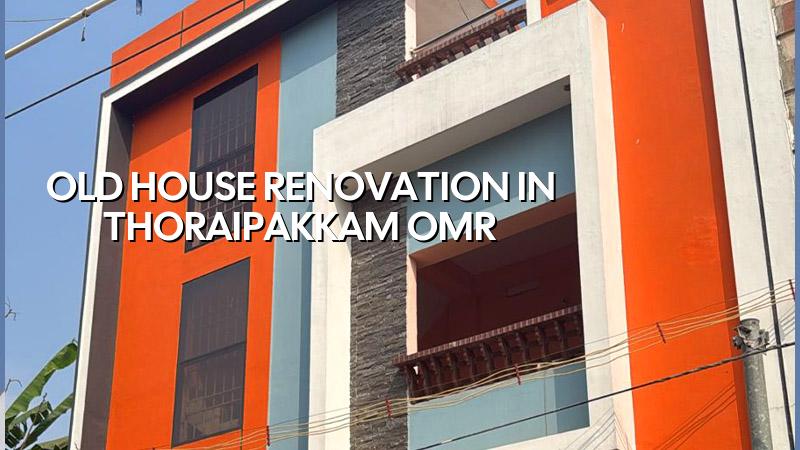
Old House Renovation in Thoraipakkam OMR
Old house renovation in Thoraipakkam OMR usually starts because the home has stopped behaving like a home. You see damp patches after a hard rain, hairline cracks that have widened, a kitchen that no longer works for the family, or rooms that feel dark and tired even after a repaint.
We look at renovation differently from a fresh build. The first job is to find out what can be kept, what must be repaired, and what should be replaced before you spend money on finishes. In an old house, the hidden parts decide the final result.
What changes in this part of OMR
Thoraipakkam sits on the OMR belt where many plots have gone from independent houses to apartment streets, and old homes now stand beside newer buildings and heavier traffic. The practical problem is not just age. It is access, drainage, neighbour proximity and how much of the original structure is still worth saving.
In this side of Chennai, monsoon water can hang around longer than people expect. If the plinth level is low, if the site slope is wrong, or if the rainwater outlet was never properly formed, the same dampness comes back after every cosmetic repair. That is why we inspect the ground, the roof, the toilet lines and the external walls before talking about tiles or paint.
One more thing matters here. Many old houses in the OMR belt were built for smaller families and lighter services. Today you may need a larger kitchen, more toilets, split AC lines, inverter backup, better parking movement and stronger waterproofing. The old plan has to be tested against the way you live now.
What we check before we touch a wall
An old house is not a paint job with some civil work around it. We start with a condition check. Cracks are mapped, slab leakage points are marked, wall plaster is tapped for hollow sound, and any visible settlement is studied against door and window alignment. If the structure has been altered before, we look at where beams or walls may have been cut without proper support.
For Chennai homes, the engineering side matters. We work to Indian standards such as IS 456:2000 for RCC, IS 875 for loads, IS 1893:2016 for seismic design and NBC 2016 for building basics. If a home needs structural strengthening, we do not guess. We inspect, measure and then decide whether the work is repair, retrofit or partial rebuild.
Typical repair decisions
Some defects are simple. A cracked plaster line might need sealing and re-plastering. Some are not. A slab leak that has reached reinforcement needs a proper waterproofing fix and sometimes patch repair, not just another coat of white putty. A weak staircase landing, a rusted chajja or a badly altered wall opening may need structural attention before the family moves back in.
We also check the service lines. Old wiring and old plumbing often fail at the same time as the visible finishes. If you replace only the tile and leave the pipe behind it, the same wall starts staining again. That is a common mistake, and it wastes money.
- Inspect the structure — we check cracks, dampness, slab edges, beams, columns and settlement signs. This usually takes 1 to 2 site visits.
- Decide what stays — we mark the parts that can be repaired, the parts that need replacement and the parts that need strengthening.
- Prepare the BOQ — we list quantities and rates before signing. This keeps hidden work from becoming surprise billing.
- Carry out civil repairs — crack treatment, plaster removal, waterproofing, masonry correction and RCC patch work come first.
- Finish the services and interiors — plumbing, electrical, flooring, painting and joinery happen after the base work is sound.
Repair, remodel or rebuild?
This is the real decision in most old-house jobs. If the structure is sound and the family wants to improve layout and services, renovation is the right path. If the home has repeated leakage, major settlement or unsafe altered openings, repair alone can be false economy. And if the plan is badly dated, the ceiling heights are low, or the structure is too compromised, a phased rebuild may make more sense than spending heavily on surfaces.
We tell clients the uncomfortable part too. Not every old house deserves to be preserved as it is. Some deserve selective demolition. Some deserve strengthening. Some deserve a fresh plan with only the useful parts kept. The wrong choice here is to spend on interiors before checking the structure. That is how budgets disappear.
There is also a trade-off on living through the work. Staying inside the house saves rent, but it slows the job and creates dust control problems. Moving out speeds up the work, but it adds temporary accommodation cost. For a two-storey home, many owners choose a phase-wise plan: one floor at a time, then the roof and external waterproofing, then the interiors. It takes longer, but the family can manage.
- Check for damp patches that return after repainting.
- Look for diagonal cracks near openings and staircase corners.
- Ask whether old plumbing lines were ever replaced.
- Confirm the roof slope and rainwater outlet condition.
- See if the toilet and kitchen floors are lower than the surrounding rooms.
- Ask for a BOQ before any advance payment.
Cost, approvals and the work sequence
Renovation cost is not one number. It moves with how much structure is affected, how much demolition is needed, the quality of finishes you want, and how easy the site is to access. For interior works, the indicative rate is ₹1,200 to ₹2,500 per sq ft. For painting, the rate is ₹25 to ₹45 per sq ft. For a renovation project, the real figure only settles after we prepare a BOQ and see the site condition.
In Thoraipakkam, approvals depend on the nature of the work. Simple internal repair may be handled differently from structural alteration or extension. If the job changes the building footprint, height or load path, we check the applicable local approval route and prepare the drawing set and structural documents needed. We never tell a client to start work first and ask questions later. That habit causes trouble.
| Work head | What it covers | Indicative rate |
|---|---|---|
| Interior works | Partition changes, flooring, false ceiling, carpentry, electrical rewiring | ₹1,200 – ₹2,500 per sq ft |
| Painting | Wall preparation, primer, standard emulsion, labour | ₹25 – ₹45 per sq ft |
| Structural repair | Crack treatment, plaster removal, patch repair, strengthening | Depends on inspection and BOQ |
| Waterproofing | Terrace, bathroom, external wall and junction treatment | Depends on the affected area and system selected |
A sensible schedule for a medium old-house renovation usually starts with inspection and drawings, then demolition and debris removal, then repair and waterproofing, then MEP work, and finally finishes. Small jobs can finish faster. Houses with serious leakage or structural repair take longer. Monsoon work also slows down if the roof is open.
How we handle an old house like yours
We bring in our civil engineers, structural engineer and architect from the start. A site engineer is on the plot every working day, and the managing director reviews the work. Before contract signing, we prepare a detailed BOQ and write the payment stages into the contract. If you cannot visit often, we send weekly photo updates on WhatsApp. If the house is occupied, we plan the work so dust, water and movement are controlled as much as possible.
We also keep the conversation plain. If a wall can be repaired, we say so. If it should come down, we say that too. If your home needs only selective renovation, we do not push for a bigger job. You can call us on +91 97107 13838 or write to info@shalomconstruction.com, and if you want to meet, our office is at No. 45, 2nd Main Road, Abirami Nagar, Koladi (Landmark: Ratna Chamber), Thiruverkadu, Chennai – 600077.
Frequently Asked Questions
Old houses can be good houses again, but only when the hidden work is treated with respect. If you take care of the structure, the rest of the home starts to make sense again.
Old House Renovation in Thoraipakkam OMR
If you want us to look at your house, we can start with a site visit and a BOQ-based estimate. Call us or request a quote, and we'll tell you plainly what can stay, what needs repair and what should go.
Request a Quote Call +91 97107 13838