


Best Builders in Koyambedu
When you search for the best builders in Koyambedu, you are usually trying to avoid a costly mistake. You may be planning a house, a renovation, or a small commercial building near the market and bus corridor, and you need to know who will actually manage the job well.
The right builder here is not the one with the loudest claim. It is the one who can show drawings, a BOQ, the approval path, and a site team that can work around Koyambedu traffic without wasting your time or your money.
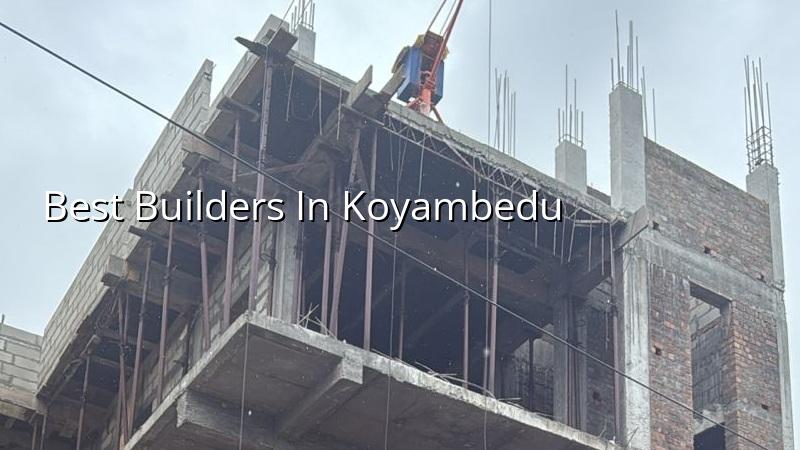
What Koyambedu changes on site
Koyambedu is not a quiet layout area where material can sit on the road all day. It sits around the CMBT market and heavy vehicle routes, so delivery timing, labour movement and neighbour coordination matter from the first day. If you miss that, the first problem is not the concrete. It is access. A mixer truck may not have space to wait, shuttering may get unloaded in the wrong place, and one blocked lane can slow the whole pour.
The area also tends to mix commercial work, apartment work and older residential plots. That means the builder has to read the plot correctly before promising a schedule. A narrow approach road needs a different method from a regular corner plot. If the site is on a busy stretch, we plan the pour window, material stacking and waste removal before work starts, not after the neighbours start complaining.
Inside Chennai, approvals matter just as much as execution. CMDA is the planning authority for the metropolitan area, while the building licence comes from the local body for the plot. For a Koyambedu site, that may mean the Corporation or the relevant local authority depending on the exact location. The documents usually come up early: patta, encumbrance certificate, FMB sketch, approved architectural drawings, structural stability certificate and drainage details.
How to verify a builder before you sign
If you are choosing between firms, ask for proof that can be checked. A good builder should not get offended by that. We would rather a client ask sharp questions than sign in a hurry and regret it six months later.
Start with the BOQ. It should break the work into heads, not hide everything inside one lump sum. Then ask who does the technical work. In-house civil engineers, a structural engineer and an architect are a safer setup than one person subcontracting every decision. Also ask how site supervision works. A site engineer should be on site every working day, not only when the client is coming around.
- Ask for the BOQ before contract signing, not after advance payment.
- Check whether structural design follows IS 456:2000, IS 1893:2016, IS 875 and NBC 2016.
- See who signs off the structural stability certificate.
- Confirm the payment stages are milestone-linked, not front-loaded.
- Ask how often you will get photo updates if you cannot visit the site.
- Look for a clear answer on who handles approvals and liaison work.
One honest warning: a builder who speaks only about finish materials and says little about foundation, drainage or site access is usually not thinking far enough ahead. In a place like Koyambedu, that gap becomes expensive. The pretty part is never the first problem.
What good construction here actually includes
For a serious residential or commercial project, the builder should cover the whole chain: soil investigation, foundation design, RCC work, masonry, plastering, waterproofing, electrical and plumbing coordination, and final handover. Chennai is in Seismic Zone III, so structural design is not a box-ticking exercise. It should be part of the way the building is planned from day one.
Foundation and structure first
We never treat the foundation as a standard item that stays the same on every plot. Soil conditions decide the logic. If the soil report shows firm strata, isolated or strip footings may work. If it shows soft layers or water-retaining ground, raft or pile options with tie beams may be the right answer. The test is cheap compared with repair work later, and in Chennai that is not a theoretical point.
The same logic applies to concrete cover, reinforcement detailing and waterproofing. In a place with traffic dust, heat and seasonal rain, sloppy execution shows up early. Honeycombing, damp patches, cracked plaster and rust stains are not “minor issues”. They are warnings that the builder cut corners where nobody could see.
| What to compare | What good looks like | What to reject |
|---|---|---|
| BOQ | Itemised, measurable, tied to drawings | One-page lump sum with vague exclusions |
| Structure | Designed to IS 456, IS 1893, IS 875 and NBC 2016 | “Standard design” with no code reference |
| Supervision | Site engineer present every working day | Visits only when the client insists |
| Payments | Linked to completed milestones | Large advance before work is visible |
How to read a fair contract
A fair contract does not try to impress you with language. It tells you what is included, what is excluded, how changes are priced, and what happens if the drawing changes midstream. In our experience, most disputes come from assumptions, not from brickwork. One side thinks painting is included. The other says only plaster and basic finish were agreed. That kind of argument is avoidable.
For builders in Koyambedu, the contract should also address logistics. Who arranges debris removal? Who manages loading and unloading in tight site conditions? Who carries the risk if road access changes during the work period? These are not small points in a dense area. They affect labour, timing and neighbourhood relations.
We also tell clients to look at payment stages. Milestone-linked payment is fair because it tracks real progress. It lets you verify foundation, slab, masonry and finishes step by step. A builder who asks for a large chunk too early may be masking weak cash flow, and that pressure often ends up on your site.
- Site check and soil test — 1 to 2 weeks, including access review, plot measurement and the foundation decision.
- Plan and approval drawings — 1 to 3 weeks, depending on revisions, local body procedure and document readiness.
- Foundation and RCC frame — 6 to 10 weeks for a typical independent house, longer if the plot needs a deeper system.
- Masonry, plastering and services — 6 to 8 weeks, with plumbing and electrical coordination during the work.
- Finishes and handover — 4 to 8 weeks, depending on tiles, paint system, joinery and waterproofing checks.
Cost, rate bands and what moves them
If you are comparing builders, price matters, but only after scope is clear. Standard residential construction in Chennai is usually in the ₹1,900 to ₹2,300 per sq ft range for G+1 with standard finishes. Mid-premium work is ₹2,300 to ₹2,800 per sq ft, and premium residential goes to ₹2,800 to ₹3,500+ per sq ft. Commercial shell and core, industrial sheds, and interior fit-outs sit in different bands. The BOQ settles the real figure before any contract is signed.
The rate moves with soil and foundation type, number of floors, span, finish level and site access. In Koyambedu, access can influence labour and material handling more than people expect. A plot with easy truck access is not the same as a plot where every bag of cement has to be hand-shifted through a tight lane. That difference shows up in time and sometimes in waste.
Saving money is sensible when you are choosing finishes, sanitaryware or a simpler elevation. Saving money is dangerous when you cut the soil test, shrink the reinforcement quality or leave waterproofing vague. Those are the parts that protect the building. Nobody notices them when they are right, and everyone notices them when they fail.
How we work on sites like this
We build with in-house civil engineers, a structural engineer and an architect. A site engineer is on site every working day, and clients who cannot visit get weekly photo updates by WhatsApp. Before contract signing, we prepare a detailed BOQ, and the payment schedule is written in milestones. That makes the work clearer for you and it keeps the site team accountable.
For design and execution, we work to Indian standards, carry out soil investigation before foundation design, and plan for rainwater harvesting, which is mandatory in Tamil Nadu. If you want to talk through a Koyambedu plot, call us at +91 97107 13838 or write to info@shalomconstruction.com. Our office is at No. 45, 2nd Main Road, Abirami Nagar, Koladi, Thiruverkadu, Chennai – 600077.
Frequently Asked Questions
We have seen enough sites to know that the cleanest-looking promise is not always the safest one. You want the builder who talks clearly about soil, approvals, access and payment stages, because those are the parts that decide whether the job stays calm or turns messy.
Best Builders in Koyambedu
Need a BOQ-based quote or a site visit for your Koyambedu plot? Call us on +91 97107 13838 or use our contact page and we will take it from there.
Request a Quote Call +91 97107 13838