


Aluminium Fabrication Contractors in Karapakkam
If you are comparing aluminium fabrication contractors in Karapakkam, you are probably trying to get a gate, grill, railing, partition or frame fixed before the rest of the work slows down. The real question is not who can bend a section and weld it. It is who can give you the right alloy, the right fixing detail and a finish that survives Chennai rain, salt air and daily use.
Karapakkam is not a place where a weak fixing detail gets forgiven. A balcony frame near OMR sees wind, dust and moisture; a gate near a busy access road takes repeated impact; a window grill that is too light starts rattling in a year. We write this page for the homeowner or builder who wants to know what to ask, what to reject and what a proper aluminium job should contain before the quotation is signed.
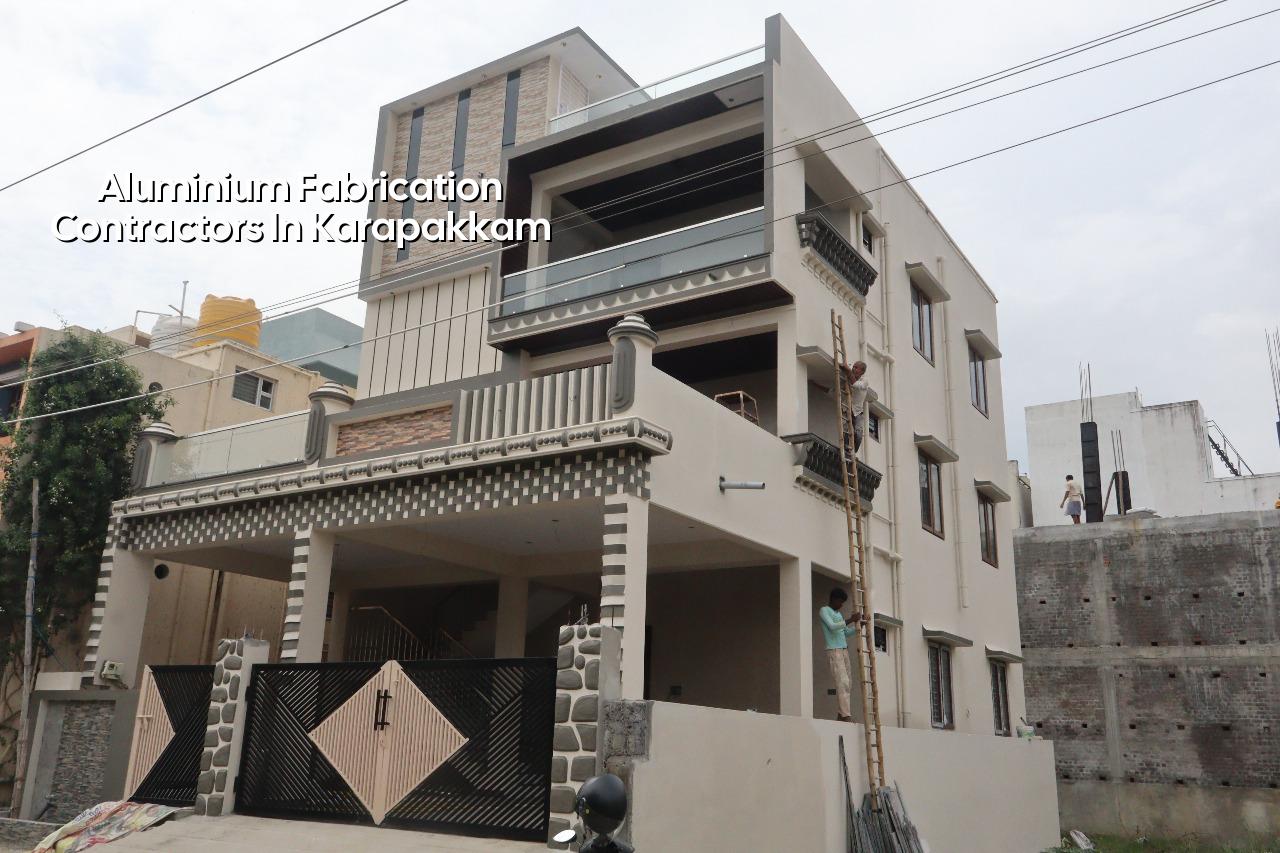
What Karapakkam sites demand
Karapakkam sits on the OMR side, with a mix of apartments, individual houses and commercial buildings. Many plots are close to water-retaining ground and some sit low enough that drainage is not an afterthought. That affects aluminium work more than people expect. If the sill level is wrong, water gets trapped at the bottom track. If the fixing is too shallow, the frame loosens. If the powder coat is poor, the first monsoon leaves stains that never fully wash out.
We also have to think about site access. On a tight plot, you cannot depend on large prefabricated pieces arriving without planning. The members need to be measured after civil plastering, because one unplumb wall changes the entire line of the frame. That is why the best work in Karapakkam is usually measured on site, made to fit the opening that actually exists, and installed after checking the level of the surrounding masonry.
The local trade-off is simple. A heavier section, better coating and better hardware cost more, but they reduce repairs later. A cheaper section may look fine on day one. Six months after the first heavy rain, the loose hinge or sagging shutter tells the truth.
Material and fixing details that matter
Aluminium fabrication is only as good as the section, the fasteners and the way it is anchored. We use the word aluminium loosely in common speech, but the job should still be specified with care: section thickness, frame size, panel type, mesh type where needed, hardware brand or grade, coating type and the substrate it is fixed into. For Chennai buildings, that detail matters because thermal movement, moisture and dust all act on the joints.
What a proper specification usually covers
For grills, windows, partitions, balcony protection and gate infill, we look at the opening first and then decide the section. A wide shutter needs more stiffness. A tall railing needs better lateral resistance. A window near the sea side or an exposed road needs better surface treatment than an internal partition. The surface finish is not just about appearance; it decides how soon the surface starts chalking, fading or staining.
Where the aluminium piece meets masonry or RCC, the anchor detail should be clean. Poor installers often rely on a few quick screws and hope the plaster holds. It does not. The correct fix depends on the wall condition, the thickness available and whether we are fixing into RCC, block work or an already finished surface. We also leave room for movement. A tight, unforgiving joint tends to crack the surrounding plaster.
- Measure the opening — after plaster and final civil alignment, usually 1 visit and a short recheck before fabrication.
- Confirm the section and hardware — frame size, thickness, hinges, locks, rollers or mesh chosen to suit the use, about 1 to 2 days.
- Fabricate in the workshop — cutting, joining, edge finishing and trial assembly, often 3 to 7 days depending on quantity.
- Install on site — fixing, alignment, sealing and touch-up, usually 1 to 3 days for a small home job.
- Check movement and finish — shutters should open freely, no rubbing, no visible gap at the latch side, done the same day.
How to verify a fabricator before you pay
If you are choosing between firms, don’t start with the quotation total. Start with the details that show whether the person has actually done the work. A fair fabricator should be able to explain what section is being used, why it is being used, what the fixing method is and how the finish will hold up near your specific plot. If the answer is only “good quality” and “best rate”, keep asking.
Ask for a written scope. The problem in aluminium work is not usually the metal itself. It is the gap between what the client imagined and what the contractor included. One side thinks the quote includes handles, mesh and installation. The other side meant only the frame. That misunderstanding causes more arguments than the fabrication itself.
- Ask for the section size and thickness in writing, not just a brand promise.
- Check whether the quotation includes installation, sealing and touch-up.
- Confirm what happens if the opening size changes after plastering.
- Look at hinge, lock and fastener details, because hardware fails before the aluminium does.
- Ask how the surface finish handles rain, dust and cleaning chemicals.
- Read the payment stages; no proper job should be paid in one lump before site measurement and fabrication.
The honest limitation is this: aluminium is not the right answer for every opening. In a heavily load-bearing gate or a long-span item with repeated impact, steel may be the better call. In a very damp or poorly detailed corner, even aluminium will suffer if the surrounding masonry traps water. The contractor should say that plainly. If they never say no, they are not helping you.
What affects the rate
People ask for a price per square foot, but aluminium fabrication does not always fit neatly into one number. The rate moves with section thickness, profile complexity, finish, hardware, site access and whether the job is a simple grille or a more detailed shutter or partition. For Chennai residential work, the labour and material mix also shifts with the amount of cutting and fitting needed on site.
We do not quote a total project price here because a proper BOQ settles the real figure before any contract is signed. What we can say is that the related interior or fit-out type of work often sits in the broader Chennai range of ₹1,200 to ₹2,500 per sq ft, but aluminium fabrication itself is priced by item, by section and by finish. That is why a small gate with decent hardware may cost more than a large but simple fixed screen. Size alone does not tell the story.
| Job type | What changes the price | What you should insist on |
|---|---|---|
| Window grill or safety screen | Section thickness, opening size, finish | Exact section, anchor detail, clean edges |
| Balcony railing | Length, height, handrail profile, exposure | Sturdy fixing and corrosion-aware finish |
| Sliding shutter or partition | Track quality, panel weight, hardware | Smooth movement and proper sealing |
| Gate or access shutter | Span, hinge load, lock set, daily use | Reinforced fixing and tested alignment |
How we handle this work
We handle aluminium-related work through our in-house civil engineers and site team, so the fabrication is not treated as a loose add-on to the building. The site engineer checks the opening, the structural team checks the fixing condition and our architect coordinates the finish so the item fits the building rather than fighting it. That matters in Karapakkam, where many jobs sit inside larger residential or mixed-use projects and the tolerance for rework is low.
We give a detailed BOQ before any contract is signed, and we keep the payment stages milestone-linked. If you cannot visit the site often, we can share weekly photo updates by WhatsApp. For a site discussion or a scope check, call +91 97107 13838 or write to info@shalomconstruction.com. Our office is at No. 45, 2nd Main Road, Abirami Nagar, Koladi, Thiruverkadu, Chennai – 600077.
Frequently Asked Questions
If you want aluminium work that fits the building instead of looking like it was forced onto it, start with a proper measurement and a written scope. That is the part most problems never survive.
Aluminium Fabrication Contractors in Karapakkam
Tell us what opening you have, and we can help with a site visit, scope check or BOQ-based quotation.
Request a Quote Call +91 97107 13838