


Trusted Construction Company in Porur
When you search for a trusted construction company in Porur, you’re usually trying to protect a plot, a budget, and a deadline at the same time. You want a builder who can handle the paperwork, read the soil properly, and keep the site moving without turning every small change into a bill.
Porur is not a place where you can guess your way through a build. The roads carry heavy traffic, the site access can be tight, and many projects sit between apartments, hospitals, offices, and older houses. We write this page to help you judge the work properly before you sign anything.
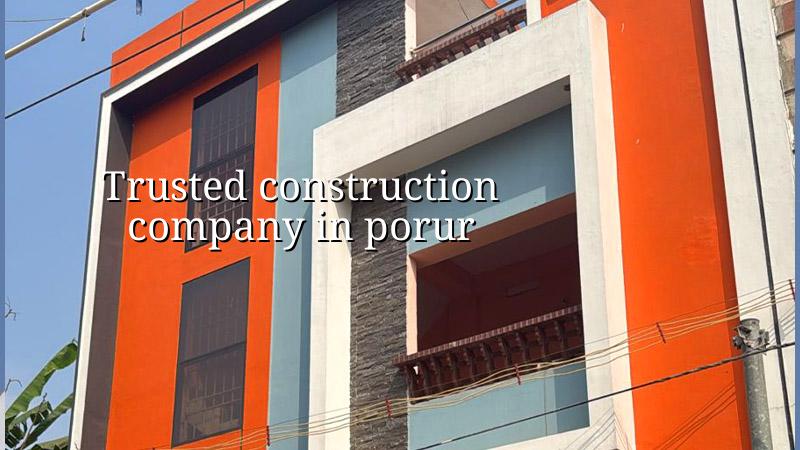
What Porur Demands from a Builder
Porur sits on a busy west Chennai junction, with Mount-Poonamallee Road, the lake side, IT traffic, hospital traffic, and neighbourhood traffic all meeting in the same area. That matters during construction. A concrete truck may not get in at the time you want. Sand, steel, shuttering plates, and labour have to be planned around the road, not around a neat office schedule.
The other thing people miss is plot variety. In this belt you see regular house plots, apartment sites, redevelopment work, and commercial work close by. A builder who is fine for one of those can still be poor for another. The supervision style changes, the approvals change, and the way materials are staged changes too.
Porur is also one of those places where a mistake in site level or drainage shows up fast. Water does not forgive a weak slope. If the plot sits lower than the road or the neighbouring compound, the plinth level and rainwater route have to be settled at the start, not after the first monsoon complaint.
What We Check Before We Promise a Price
A trusted construction company should not give you a neat number and hope the rest works out later. The real job is to remove surprises. We start with the plot, the soil, the access, the number of floors, the finish level, and the approval route. Then we prepare the BOQ so you can see where the money goes. That is what keeps the contract fair.
Soil, access and services
We first look at whether the ground is likely to behave like firm red soil or softer water-retaining ground. In west Chennai, that difference decides whether simple isolated footings are enough or whether the foundation plan needs more care. We do not guess the bearing capacity. Soil investigation tells us that. A cheap test is far better than discovering settlement after the walls are up.
Access matters just as much. If the lorry cannot turn, the labour has to carry. If the street is narrow, the storage plan has to shrink. If the site is next to an operating building, the work sequence has to reduce dust, noise, and nuisance. These are not small issues. They change cost, timing, and the kind of contract you should sign.
- Plot review — we check the site, road access, neighbour edges, and whether the plot needs level correction before work starts. This usually takes a day or two.
- Soil investigation and design — we study the test results, then frame the foundation and structural design to IS 456:2000, IS 1893:2016, IS 875, and NBC 2016. This stage often takes one to two weeks.
- BOQ and contract — we prepare the quantity list, final scope, payment milestones, and exclusions. You should read this line by line before signing.
- Execution and checks — our site engineer is on site every working day, and we inspect steel, shuttering, concrete, waterproofing, and finish samples at the right stage.
- Handover — we close the punch list, test what needs testing, and hand over the finished work with the agreed documents.
How to Verify a Builder Before You Sign
This is the part most people skip, and it costs them later. If a builder is truly reliable, they should not be offended by questions. Ask for the BOQ before the contract, not after. Ask who actually supervises the site every day. Ask what is included in the quoted rate and what is not. Ask how changes are priced. If the answers are vague, the contract will be vague too.
A fair construction contract should also say how payments are linked to stages. You should not be paying a large chunk before the foundation is done, and you should not be left with no leverage near the finish stage. Milestone-linked payment protects both sides. It keeps the builder funded and keeps you from paying ahead of the work.
Check the drawings too. A good builder should be able to show you the architectural set, the structural logic, and the approval path. In Chennai, approvals may involve CMDA, and the licence body depends on the exact location. Inside Corporation limits the licence route is different from a municipality or town panchayat. Near the airport side, an AAI height clearance can come into play. Those things should be handled before the first major commitment, not after construction is underway.
- Ask for a BOQ with material, labour, and finish heads clearly split.
- Check whether the site has a named engineer on it every working day.
- Read the contract clauses for variation work, delays, and payment stages.
- Look at the approval path for your exact plot, not a generic Chennai example.
- Confirm how rainwater harvesting and drainage details are included in the drawings.
- See one or two material samples if the finish level matters to you.
Rates, scope and the trade-off you need to decide
For residential construction in Chennai, the indicative rate depends on finish level. Standard residential work for a G+1 home usually sits around ₹1,900 to ₹2,300 per sq ft. Mid-premium work is usually ₹2,300 to ₹2,800 per sq ft, and premium or luxury work can move from ₹2,800 to ₹3,500+ per sq ft. Those are only starting bands. Soil, foundation type, number of floors, span, finish level, and site access all move the figure. The BOQ settles the real cost before any contract is signed.
The trade-off is simple. You can save money by keeping finishes modest, simplifying the plan, and avoiding last-minute changes. That is sensible. You should not save money by cutting steel, trimming concrete quality, skipping soil investigation, or weakening waterproofing. Those are false savings. They look cheap in month one and expensive in year three.
People also ask whether a turnkey contract is better than piecework or labour-only work. For a first-time owner in Porur, turnkey is usually safer because one team owns the coordination. The case against turnkey is also real: if the scope is not written cleanly, the builder can hide cost in assumptions. So the contract has to be specific. If you want lower upfront control and are ready to manage vendors yourself, labour-only can work. Most owners are not ready for that.
| Cost head | What moves it | What you should check |
|---|---|---|
| Foundation | Soil condition, test result, footing type | Soil report, design logic, excavation depth |
| Structure | Number of floors, span, column grid | Structural drawings, steel schedule, concrete grade |
| Finishes | Tile choice, paint system, doors, hardware | Material brand list and sample approvals |
| Site overheads | Access, storage, labour movement, safety | Site logistics plan and supervision frequency |
Why Porur needs disciplined supervision
Porur has the kind of mixed site condition that punishes casual supervision. One plot may be on a cleaner regular layout road, another may be squeezed near existing buildings, and another may need extra care because of service lines, traffic, or drainage. If the engineer is not actually there, small mistakes become hidden defects. A beam shuttering misalignment. A slab level that drifts. A waterproofing detail that gets value-engineered away. You only notice later.
We have seen the second week of monsoon ruin a relaxed site more times than we can count. The ground turns soft around stacked materials, the access road gets muddy, and the same loading point that worked in summer suddenly becomes a bottleneck. A site team that plans for that week does better than one that only plans for the photo on day one.
In Porur, the approval file also has to be kept tidy. Patta, encumbrance certificate, FMB sketch, approved architectural drawings, structural stability certificate, and drainage details are the usual papers people ask us about. If the plot is in a special approval zone or near the airport side, we confirm what else is needed before work starts. Guessing at paperwork is a waste of time.
How we work on a Porur project
We handle residential construction, villas, apartments, commercial work, industrial buildings, architectural and structural design, interior works, and structural renovation from our own team. The civil engineers, structural engineer, and architect work in-house. Mr. D. Salamon Ashok Rajan reviews projects personally, and our site engineer is on site every working day. Clients who cannot visit get weekly photo updates by WhatsApp. If you want to speak with us about a plot in Porur, call +91 97107 13838, use the alternate number +91 99941 32004, or write to info@shalomconstruction.com. Our office is at No. 45, 2nd Main Road, Abirami Nagar, Koladi, Thiruverkadu, Chennai – 600077.
Frequently Asked Questions
If you’re comparing builders for a plot in Porur, start with the papers, the BOQ, and the supervision plan. Those three tell you far more than a polished brochure ever will.
Trusted Construction Company in Porur
If you want a BOQ-based quote or a site visit for your Porur plot, get in touch and we’ll discuss the ground, approvals, and scope before anything is fixed.
Request a Quote Call +91 97107 13838